
Drone Show Triple Geofencing, Explained: 3 Layers of Safety
Simple hard and soft geofences aren't sufficient for drone shows. Verge Aero engineered a three-layer geofencing architecture — Soft Geofence, Predictive Trajectory Geofence, and Hard Geofence — running on independent processors to eliminate single points of failure.
Most drone show systems rely on a simple two-boundary geofencing model inherited from consumer drones. Verge Aero's approach is fundamentally different: three independent layers, two of them running on separate processors from the flight controller, designed to catch problems early — not just at the boundary.
The Limitations of the Traditional Drone Show Geofence Model
The traditional approach uses two concentric boundaries around the show airspace: a soft geofence at the outer edge, which triggers an alert and return-to-home command; and a hard geofence at the edge of the show's airspace, which cuts the drone's motors if breached.
On paper, this sounds reasonable. In practice, it has serious gaps:
- This kind of soft geofence is measured from the edge of the show airspace, not the drone's intended position. In this model, a drone can drift dozens of meters off its planned path and never trigger a return-to-home.
- The hard geofence by itself is purely reactive: it responds when a drone crosses the line. But at typical drone show flight speeds, momentum can carry a drone well past the safety boundary after motors cut.
- In many implementations, both geofences share a processor with the flight controller. A single software fault can disable all three simultaneously — the exact scenario safety systems are meant to prevent.
Verge Aero's three-layer architecture addresses each of these gaps directly.
A Smarter Approach to Drone Show Geofencing
The Soft "Dynamic Bubble" Geofence
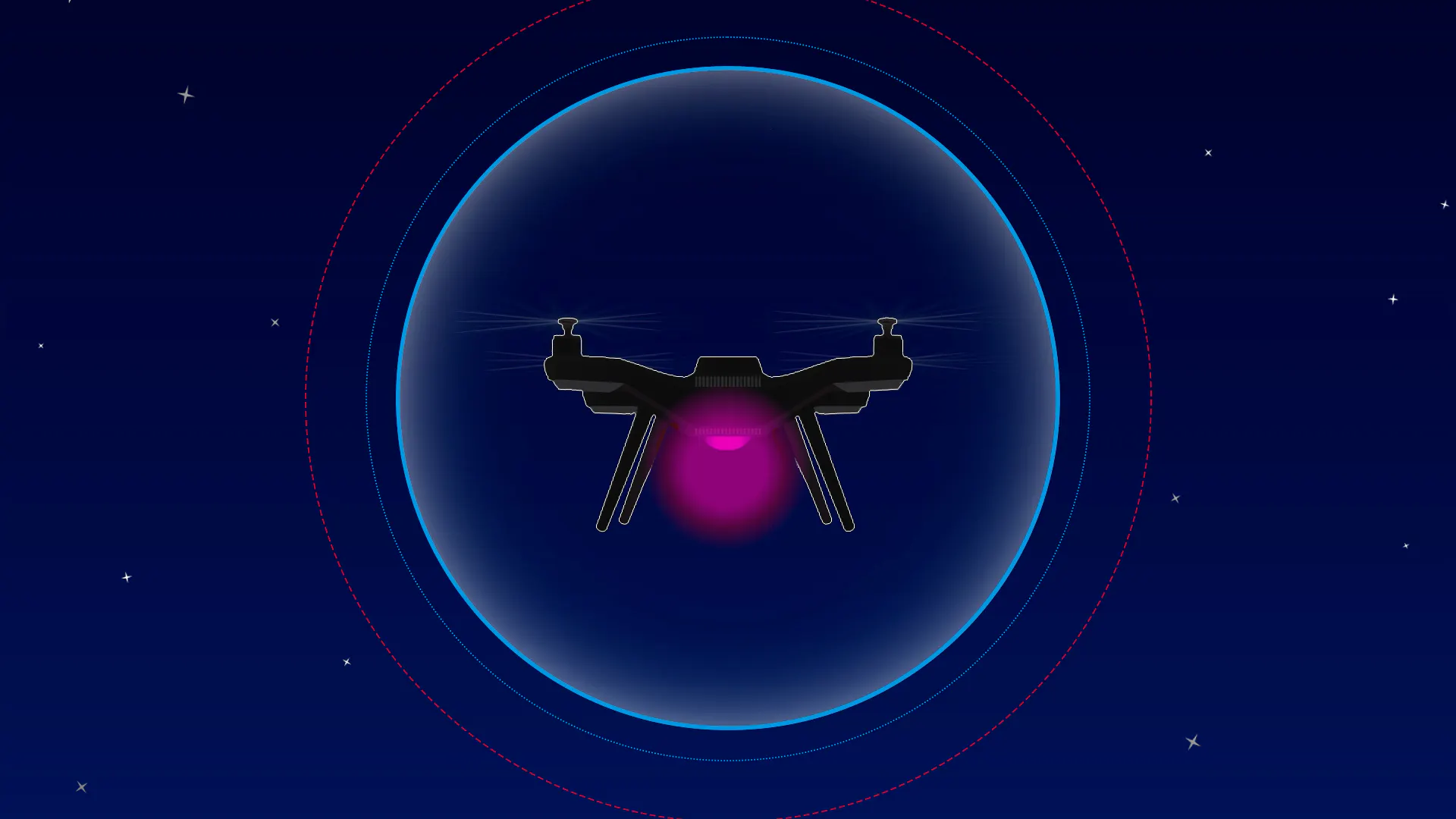
The soft geofence is the first line of defense. In the Verge Aero platform, rather than drawing a fixed boundary at the edge of the show airspace, the soft geofence — known as a Dynamic Bubble — travels with each drone's intended position throughout the flight.
With Dynamic Bubble geofencing, each drone is required to stay within a tight radius of its target position at every moment of the flight, enforcing precision at the individual aircraft level — because a drone should always be at its target position, not simply to be somewhere inside the show boundary.
Why this matters:
- Navigation errors and wind drift are caught early, while the drone is still well within the safe zone and while there's time to correct.
- The Dynamic Bubble provides a continuous health signal: if a drone consistently struggles to stay within its bubble, that's a real-time indicator of a navigation or hardware issue that the system can act on.
Predictive Trajectory Geofence
Say a drone ignores the soft geofence and is headed for the hard geofence. We can't ignore physics: a drone doesn't just stop the moment its motors cut if it has already built momentum. In many cases with the old two-layer method, out-of-control drones have landed well beyond the safety zone.
Verge Aero's Predictive Trajectory Geofence solves this by being proactive rather than reactive. Rather than wait for a drone to reach the hard boundary, this system continuously projects the drone's trajectory, and — given the drone's current speed, direction, and the physics of deceleration — is ready to cut the motors at the right moment to ensure it never breaches the hard geofence.
The practical result is that a drone running a serious navigational fault will be stopped before it ever reaches the edge of the safety zone. The Hard Geofence, described below, becomes a true final boundary rather than the first thing standing between a runaway drone and the audience.
Hard Geofence
The Hard Geofence is intentionally simple: an absolute outer boundary encompassing the entire show airspace. If a drone reaches this final layer, the response is immediate and non-negotiable: motors off, no exceptions.
Unlike the Dynamic Bubble and the Predictive Trajectory Geofence, the Hard Geofence is purely reactive. If a problematic drone somehow bypasses the other two fences, the hard geofence is set with sufficient clearance from the show's audience zones to guarantee that it will never reach the crowd — even accounting for the momentum it carries after its motors are cut.
The Hard Geofence boundary is positioned to make the worst-case outcome — a drone at maximum speed reaching the boundary — still safe.
Independent Processors: No Single Point of Failure
Running all three geofencing systems on shared hardware would create a critical vulnerability — one processor crash could disable everything. To prevent this, each Verge Aero drone runs its Dynamic Bubble and Predictive Trajectory Geofence on separate onboard computers, apart from the primary flight controller, while the Hard Geofence operates on a dedicated safety processor. Each layer functions independently: a flight controller failure won't disable the geofences, and vice versa. This architecture underpins Verge Aero's status as the only swarm drone manufacturer with EASA Design Verification Report (DVR) approval.
A System Designed to Stop Problems Before They Start
The key to Verge Aero's geofencing architecture is sequencing: the Dynamic Bubble catches deviations early, the Predictive Trajectory Geofence stops runaway drones before they reach the boundary, and the Hard Geofence serves as a backstop that should never need to trigger.
In most operations, the Dynamic Bubble ensures accurate positioning — the other layers exist for when something unexpected happens, an inevitability at scale.
What sets Verge Aero apart is having built these three layers from the ground up. Advanced geofencing is engineered into each drone from inception, and integrated with Verge Studio so operators can visualize the full safety envelope before every show.
To learn more about how Verge Aero approaches safety across navigation, software, communication, and training, visit our Safety page, explore the full system, or read The Essential Guide to Drone Show Safety.
Further Reading
Starting a Drone Show Operation – Verge Aero
The complete guide to launching a drone light show business: ROI projections, licensing requirements, system comparisons, and real success s...
READ MORE
Everything About Drone Light Shows (2026 Update) – Verge Aero
Verge Aero's 2026 guide to drone light shows: how shows work, what's on a show drone, AI-assisted design, safety and geofencing, regulations...
READ MORE
Press Release: New Drone Show Safety Standards Task Group
June 2025 – In response to recent safety incidents, drone technology leaders call on industry to join forces to develop formal technical sta...
READ MORE